
| Actors: Isaach De Bankolé, Giulia Boschi, François Cluzet, Jean-Claude Adelin, Laurent Arnal Director: Claire Denis Creators: Robert Alazraki, Claire Denis, Claudine Merlin, Monica Coleman, Alain Belmondo, Gérard Crosnier, Jean-Pol Fargeau Genres: Indie & Art House, Drama Sub-Genres: Indie & Art House, Family Life Studio: MGM (Video & DVD) Format: DVD - Color,Widescreen,Letterboxed - Closed-captioned,Subtitled DVD Release Date: 07/24/2001 Release Year: 2001 Run Time: 1hr 45min Screens: Color,Widescreen,Letterboxed Number of Discs: 1 SwapaDVD Credits: 1 Total Copies: 0 Members Wishing: 3 MPAA Rating: PG-13 (Parental Guidance Suggested) Languages: French Subtitles: English, Spanish, French |
Member $avings: $5,190,013.79
|
DVDs Available: 88,024
|
Members Online: 15
Your source for swapping dvds online... Watch...Swap...Save
Search - Chocolat on DVD
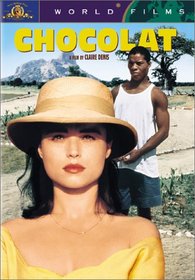  | Chocolat Actors: Isaach De Bankolé, Giulia Boschi, François Cluzet, Jean-Claude Adelin, Laurent Arnal Director: Claire Denis Genres: Indie & Art House, Drama PG-13 2001 1hr 45min "Erotic, sophisticated, and distinctive" (L.A. Weekly), this enthralling depiction of a family's struggle during the final years of French colonialism in Africa takes a profound look at the intricate nature of relationship... more » |
Larger Image |
Movie DetailsSimilar Movies
Similarly Requested DVDs
|
Movie ReviewsFrench Colonialism in Cameroon Debbie Lee Wesselmann | the Lehigh Valley, PA | 10/12/2004 (4 out of 5 stars) "Not to be confused with the Miramax film starring Juliette Binoche, Claire Denis's "Chocolat" documents French colonialism in Cameroon through the eyes of a young French girl named France, her mother Aimée, her father Marc, and their servant Protée. The film begins in present day Cameroon with an adult France accepting a ride from a black man and his son. Soon, we are swept back to her childhood, spent in a roomy house staffed with servants. One such servant, Protée, has a special, almost secret relationship with France as he teaches her bits of his culture and keeps her out of trouble. As more white people descend upon the family, Protée is pushed to the edge, especially when Aimée suggests that she, too, has demands. The effect on France, who trusts Protée more than she does anyone else, is devastating. The quiet unfolding of relationships and the introduction of new characters is more episodic than connected - little intimate glimpses here and there. Shot in long, sweeping, often silent frames, this movie is as much about what isn't said as what is. Emotions are never explained but instead flash across the faces of the actors. This French art house film gives more weight to the cinematography, fixing its characters in tableaux, than to the spare plot. The acting is understated and often enigmatic, allowing the psychology of the characters to emerge with subtlety, and the scenes are shot without much context. Despite this, "Chocolat" has a quiet, simple power. Not for the impatient, this film will appeal to those who are willing to sit back and be transported into the unique artistic vision of its director. Recommended for Francophiles and those with an interest in colonial-period Africa." A subtle and sensitive movie Debbie Lee Wesselmann | 05/05/2000 (4 out of 5 stars) "This is a very unusual movie, and perhaps not for everyone's taste. Enormous tension builds up in the movie, but it doesn't explode. There's no climax (and/or anti-climax). The tension just dissipates away strangely; it's not one of those "feel good" movies. The arid beauty of the movie's scenery is striking, and is a welcome counterpart to jungles and safaris in most other Africa movies. The movie seems to possess a number of allegorical dimensions about life and history, not restricted to the French colonial experiences.The young French woman who has returned to Cameroon seems to be in search of something, be it memory, or something to identify with her childhood experiences there, but like the characters which her reminiscence conjures up, she is faced with some kind of impenetrability. It's like what her father told her about horizon when she was a litle girl, "The closer you get to that line, the further it moves. If you walk toward it, it moves away. It flees from you. I must also explain this to you. You see the line. You see it, but it doesn't exist". All the time, there is a precarious sense of equilibrium and balance, but any attempt at 'something more' is nearly impossible, and the people in the movie know it." A French woman's memories of childhood in Africa iloveprovence | 01/28/2001 (5 out of 5 stars) "A little French girl grows up and returns to French West Africa after its independence. She remembers her friendships with Africans that were tempered by colonial restrictions on whites and blacks: her beautiful mother's ennui with Africa but also the pain she felt for being attracted to a young, black house servant. The house servant, when banished from the house to work in the compound at a "distance" from the lady of the house, teachers little Claire, by allowing her to place her hand on a steaming hot pipe, not to trust as she so readily did when she copied his African culturalisms. This act has a profound, life-altering affect on Claire and inspires her to return to Africa after having been away for a number of years. She is searching for her "lost, " trusting soul when she returns, haunted by the memories of the house servant she loved and cherishes in her memories." The "other" Chocolat, a photographic masterpiece. Mary Whipple | New England | 12/18/2004 (4 out of 5 stars) "Much less famous than the 2001 film with the same title, this French film (with subtitles), originally produced in 1989, is set in French colonial Cameroon. Written and directed by Claire Denis, it is the semi-autobiographical tale of a child growing up as the daughter of the French governor of a remote part of Cameroon. The film opens in 1989 with an African man and his son swimming and playing tag at the beach, while from a distance, France Dalens (Mireille Perrier), a woman of about thirty, sits in the shade and watches. This separation sets the scene for the entire film, as the white and black characters occupy totally different spaces. When the man, Mungo, offers her a ride to the nearest town, she takes it, the scenery on the ride calling up memories of her childhood, to which the film flashes back.
The film has very little dialogue, the director using the camera to tell the story visually, highlighting the unspoken dialogues within the characters. France, the child (Cecile Ducasse), is able to participate in the life of the black servants, especially Protee (Isaach De Bankole), the handsome "house boy," who teaches her to eat insects, among other things, while she is also being educated by her mother, Aimee, in the ways of colonial society. Aimee (Giulia Boschi), often alone in this remote area while her husband is traveling, is clearly attracted to Protee, though never a word reveals this. Gestures, glances, and the camera's observations make the sexual tension clear. When an airplane is forced to make an emergency landing and the crew and passengers come to the house to stay until parts can be brought in and a new runway built, the added tensions, and one visiting Frenchman's suspicions about Aimee's attraction to Protee, lead to dramatic confrontations and changes. The camera work (Robert Alazraki) is brilliant. The viewer could freeze-frame any scene and end up with photograph of stunning composition, color, and psychological revelation. Architectural framing, lines and angles drawing the eye into the scene in the manner of great paintings, and stark contrasts of texture, light, characters, and color make the film an unforgettable experience. Though the colonial story is not unusual, its presentation as a visual story, rather than as a verbal one, results in a subtlety that is refreshing, though this approach also leads to a story without a great deal of overt drama. Students of cinematography, photography, and painting, however, may find the visual artistry of this film so exciting that its dramatic limitations seem less significant. Mary Whipple " |


